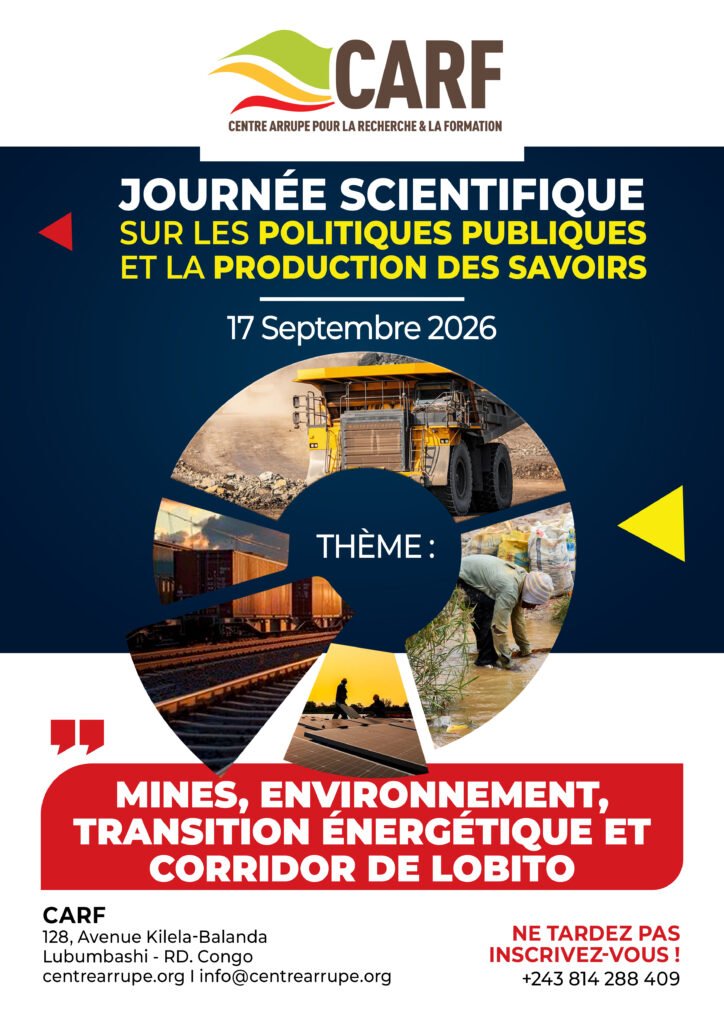
The Democratic Republic of the Congo faces several major transformations that redefine the role of its natural resources in African and global economies. The energy transition, the growth of critical and strategic minerals, the reorganization of global supply chains, new regional infrastructure and geopolitical rivalries around these resources place the DRC at the heart of issues that go far beyond the mining sector.
Copper, cobalt, lithium, tantalum, niobium, rare earths and other mineral resources are now strategic assets for the energy, digital and industry sectors. The DRC enjoys exceptional geological richness. However, this advantage does not automatically guarantee increased development. The key issue is now the capacity of the Congolese State to know, manage, value, transform and negotiate these resources in the interest of national development and the well-being of its people.
Click on this link to read the TDR complete: Here
This problem becomes all the more crucial with recent developments in the Congolese regulatory framework. The Interministerial Order of 29 June 2026, which regulates the marketing, export and nomenclature of mining products, aims to define clearly the categories of mining products, their marketing and export conditions and their methods of recovery. Its annex includes a detailed nomenclature of basic and precious metals, chemical compounds, alloys, single and mixed concentrates, rare earths and other mining products.
This reflects a key public policy concern: How can the DRC be prevented from remaining primarily a space for extraction and disposal of raw materials, even though it has the resources to build industrial value chains? This issue is all the more important because some regulatory measures directly concern the export of mining products, including copper and cobalt concentrates.
Sovereignty over strategic resources is not just about copper and cobalt. Recent developments in uranium are encouraging further reflection on the strategic governance of the subsoil. The agreement on civil nuclear cooperation signed in May 2026 between Rwanda and the United States, with the support of the IAEA, highlights a crucial issue for policy in the DRC, which has significant historical reserves of uranium: how can we put in place, today, institutions, scientific expertise, traceability mechanisms and international partnerships to ensure that the country values its strategic resources and is not merely a supplier of raw materials?
Sovereignty over resources does not depend solely on the legal ownership of the subsoil. It also involves the ability to quantify resources, analyse markets, predict technological innovations, assess social and environmental impacts, manage contracts, monitor trade flows, and produce the data needed for public decision-making. To this end, universities, research centres, public administrations and civil society organisations play a key role. Four researchers associated with the Arrupe Centre for Research and Training (CARF) will present the results of their research and will deepen the questioning directly on the production of knowledge.
The Lobito Corridor provides a territorial and geoeconomic perspective for this analysis. The railway linking the mining areas of southern DRC to the port of Lobito can greatly facilitate access to international markets and strengthen economic cooperation between the DRC, Angola and Zambia. The concession announced in August 2026 for the Dilolo-Sakania section, particularly the Lubumbashi, Tenke and Kolwezi axis, is a major step in the development of the DRC's mining and logistical infrastructure policies.
Transport infrastructure does not necessarily guarantee development policy. It can facilitate the export of minerals or encourage the economic transformation of the regions crossed. The challenge is therefore to define what type of corridor the DRC wants to establish: a simple transition to raw materials or a real centre for production, processing, innovation, employment and value creation.
Scientific Day of 17 September 2026 This is the perspective. It intends to examine, on the basis of the realities of Upper Katanga and the DRC, the conditions under which scientific knowledge can contribute to a new generation of public mining, energy, environmental and territorial policies.
The issue is no longer just how many minerals the DRC owns or how much it can export, but how it can transform its mineral heritage, infrastructure, knowledge and human capital into sustainable capacities for development and sovereignty.