
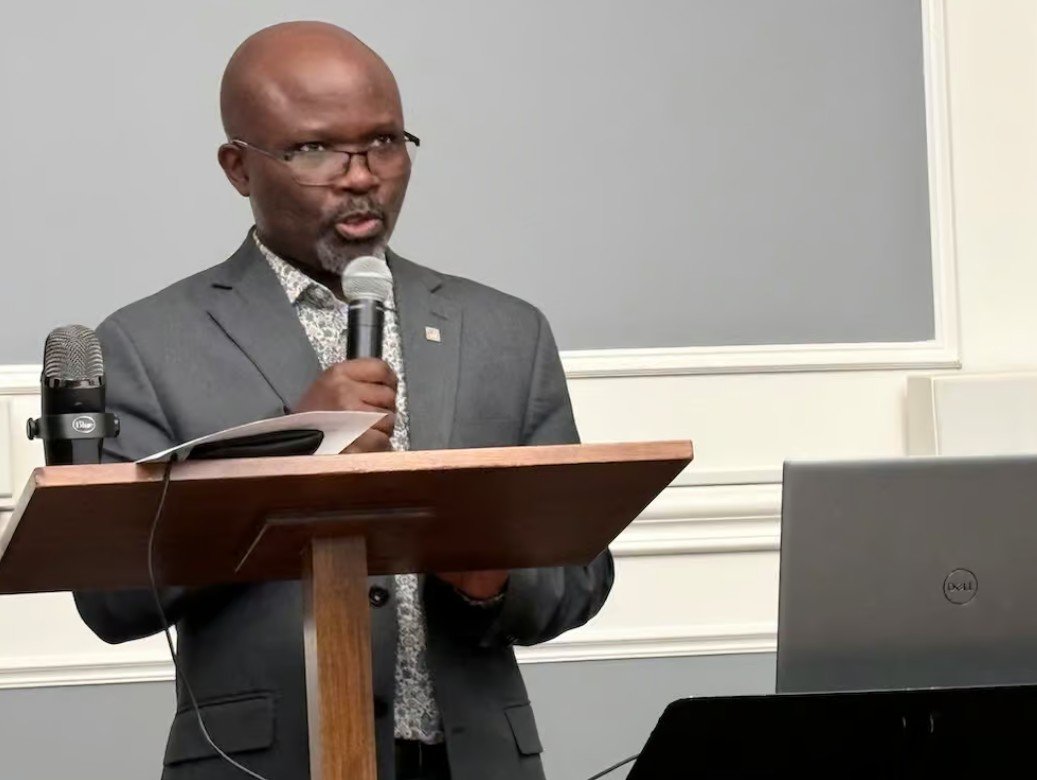
The question is not where the world needs to transition to renewable energy but "under what conditions" it can be just, says Fr. Touissant Kafarhire Murhula, SJ, Director of the Arrupe Center for Research and Training (CARF) in the Democratic Republic of the Congo (DRC). Photo: T. Sison/CJI
Watch the recordingHere.
The global shift towards renewable energy, far from being a universal benefit, risks reproducing colonial patterns of extraction and inequality in the Global South, warned Fr. Tuissant Kafarhire Murhula, SJ, Director of the Arrupe Center for Research and Training (CARF) in the Democratic Republic of the Congo (DRC).
Africa holds much of the world has critical minerals such as cobalt, lithium, copper, coltan and other rare earth elements, and yet its communities bear the environmental and human costs while economic benefits flow elsewhere, he said. Fr. Murhula was the guest speaker at a forum, Balancing Development and Ecological Justice in the Global South, which was co-hosted by Canadian Jesus International (CJI), Regis College, and the University of St. Michael
Fr. Murhula noted that even through the DRC produced 70 to 75 per cent of the world $2.50 a day. Coltan, which is needed for producing phones and computer chips have been driving conflicts in Africa, he said. He also described the unsafe mining conditions, child labour, displacement of communities, and ecological destruction that results from the extraction of minerals.
"Africa has once again been positioned to absorb the negative externalities of global technological transformation — not by accident, but because of the structures that have been set in place," said Fr. Murhula.
Multinational corporations,weak regulations, and unequal global economic systems continue to position Africa "as a reservoir of raw material" which "environmental and human costs remain acceptable in the pursuit of prosperity elsewhere," he said. The prevailing "extractive model" not only risks reproducing patterns of colonial dependence, it also results in ecological degradation and social injustice, he added. He noted that neoliberal globalization and structural adjustment programs imposed in the 1980s to the 1990s by institutions such as the International Monetary Fund and World Bank further weakened the ability of African states to regulate corporations, leaving a vacuum that multinationals daughter. "Development become progressively subordinated to market logical other than democratic accountability or social justice," he said.

An waitee poses a question during the event held at Regis College. Photo: T. Sison/CJI
The transition to renewable energy is "not necessarily a technological or environmental project" but "also a geopolitical and economic one," added Fr. Murhula. "Beneath the language of sustainability lies an intensive competition over the strategic resources required to power the new global economy."
He also lamented that, unlike other conflicts such as the Russian invasion of Ukraine, many conflicts in Africa, which are often "linked to struggles over strategic minerals and land, have often received far less international emergency despite costing millions of lives."
Fr. Murhula asked: "When we speak about green transition, green energy, which green transition are we discussing?" He said that if sustainability depends on "the continued sacrifice of African communities," then the green energy transition is financially unjust.
Drawing on post-colonial theory, dependence theory and critiques of neoiberal globalization, Fr. Murhula challenged the idea that development follows one universal Western path. While development is often presented as "a universal and natural process," he noted that post-colonial scholars have shown that it is "historically and politically constructed." Scholars such as Arturo Escobar, V. Y. Mudimbe, and Aimé Césaire, have argued that Africa was socially constructed as "underdeveloped" in ways that justified intervention and extraction, he added.
Fr. Murhula proposed ecological justice and the African philosophy of ubuntu ("I am because we are") as ethical counter models for development. Ubuntu emphasizes "relational humanity, solidarity, dignity, and communal responsibility" other than the accumulation of profit. He said that this view aligns with Catholic Social Teaching on dignity, solidarity, and the ecological debt thatwealthy nations owe the Global South, referencing Pope Francis的s Laudato Si. "Human blurring does not depend on money alone," he said, adding that it"cannot be separated from the well-being of others and from the ecological systems upon which life depends. "
The question is not when the world needs to transition to renewable energy but "under what conditions" it can be just, said Fr. Murhula. A just transition requires more than technology and market growth, he said. It demands stronger environmental regulation and transparent contracts, democratic governance of natural resources, accountability for multinational corporations, community participation in decision-making, equitable taxation, and investment in local industrial and technological capacity. "Africa must not continue the sacrifice zone of global prosperity. A just ecological future dependents upon recognition African societies not necessarily as suppliers of strategic resources, but as equal participants in shaping the political, economic, and moral foundations of the 21st century," he concluded.

Jenny Cafiso, Executive Director of Canadian Jesuits International
CJI Executive Director Jenny Cafiso expressed her gratitude to Fr. Murhula and expressed CJI This includes not only supporting people in the DRC who are working for change, but also working for Canadian policies that respect human dignity in Canada and internationally.
While in Toronto, Fr. Murhula also helped meetings with representatives of Canadian NGOs, churches, lawyers and labour unions working on environmental and development issues, including holding Canadian mining companies accountable for their activities overseas.


